

When the Corn Leaves Turn Brown
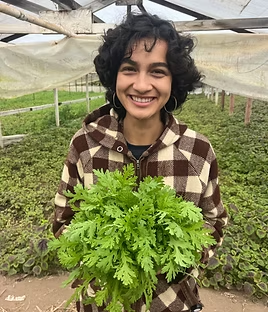
I don't know many people that would move, abruptly, from the bustling streets of New York City to a rural farm in the agricultural mecca of California. But having grown up in San Diego, a part of me has always belonged to the warmth of an unblocked sun and land that stretches without interruption. I’ve been shaped by a relationship to the Earth, one I walked away from when I left for New York—with a belly rumbling for change, convinced a different geography might satiate my hunger.
I have always been a student of extremes. If my answers weren’t at home, then they had to be on the opposite coast, in the densest city I could find. And when they were no longer in New York, I ended up in the other direction entirely—rural life, the roots of our food beneath my feet. There is something to this kind of rupture—a crack in the mirror of normality—that reveals the architecture of the world you were standing inside.
But no place holds answers. Only better questions.
After having finished a thesis exploring alternative life systems in a moment of societal collapse, I now find myself in GrizzlyCorps standing eye to eye with the working arms of the agricultural industry—asking new questions about how we have corrupted the systems that sustain us. About how far we have wandered away from the Earth.
Sandwiched between highway 1 and a Hampton Inn & Suites sits a farm owned by Apolinar (Poli), a small-scale migrant farmer. Upon arriving, the smell of wet dirt and fertilizer hung in the air, cut through by the sound of cars speeding down the freeway. Poli walked us through his strawberry fields, explaining that he needed help with a yearly state report—one meant to track how much nitrogen farmers put into and take out of the soil. This measure aims to prevent groundwater contamination, a problem caused by industrial farms.
The report is incredibly tedious and entirely in English. Poli only speaks Spanish. A hefty fine looms over a failed compliance.
Part of the report requires him to document what day and time he applied compost every month in a growing season. We asked him.
He paused. Looked over to the field, trying to remember.
He would have to think about it. He doesn’t follow a strict schedule, he told us. He knows it’s time to put down compost when the corn leaves turn brown.
His words had arrested the pulse of cars, all I could smell was strawberries.
Poli grew up in Jalisco, Mexico, where agriculture was the air he breathed. In his twenties he learned to grow strawberries from a Japanese farmer. Now in his seventies, he has been farming strawberry fields, and more, in Watsonville ever since.
Caught between freeways and hotel chains, Poli listens to the dirt—a conversation rooted across decades, generations of cultivating a relationship to the Earth.
Not long after our visit with Poli, I found myself back inside a classroom for the first time since graduation—a strange re-entry after months of boots on the ground. In a sterile little room full of wires and probes, engineers at UC Santa Cruz presented sensors that could monitor the moisture of the soil and irrigate automatically. Eventually, the sensors could track soil nutrients, deficiencies, and more—a completely automated system.
I thought of Poli and his corn leaves.

I thought of the contrast between New York and California, of the ever-widening dissonance between our minds, our bodies, our Earth.
What does it mean to live in a world where even farmers no longer listen to the dirt?
There is a kind of knowledge that cannot be encoded. It courses through the body, legible only to those who have preserved the ability to translate sense. Poli’s difficulty with the report is not about nitrogen. It is about whose languages and knowledge we’ve used to design our systems of life and whose have been left behind.

This is not a small question. It is the crack I follow from urban to rural, running beneath the American moment. The deepening fractures in our politics, our trust, our sense of shared reality — they are, at their root, a crisis of knowledge. Of who holds it, who is asked to prove it, and who gets to decide. Poli feeds the population and fails the audit.
Are the corn leaves of our world turning brown? Will we choose to listen with probes or put our ears to the ground?

Comments